
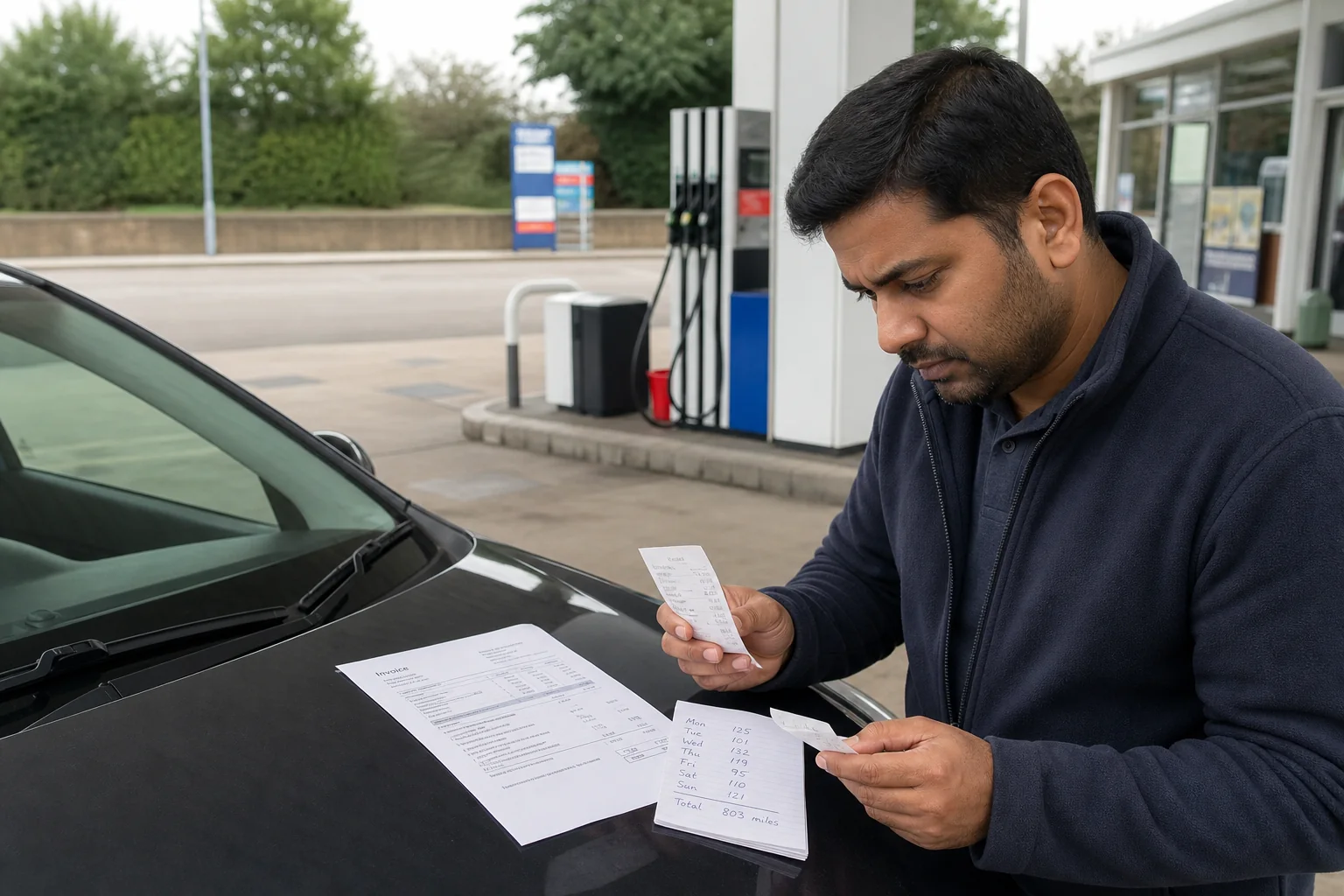
Understanding Mileage Claims
Mileage claims allow businesses and self-employed individuals to deduct vehicle costs using HMRC standard rates or actual expenses, with 2024 rates at 67 cents per mile for business use.
The standard mileage deduction simplifies tracking by applying a single rate to business miles driven. It covers multiple car expenses like fuel and depreciation without needing separate receipts. In contrast, the actual expense method requires detailed records of gas, repairs, and insurance.
Many taxpayers choose mileage claims for ease, especially with high business travel such as client visits or delivery miles. Keep a mileage log with odometer readings to separate business from commute miles. This method suits mixed-use vehicles where personal use reduces the business percentage.
Self-employed workers report on Self Assessment, while employees use Form 2106 for unreimbursed costs. Always follow substantiation rules for audit proof, using apps or GPS logs for accurate trip records.
How Standard Mileage Rates Work
Standard mileage rate multiplies business miles driven by HMRC rate (67¢/mile in 2024) covering gas, maintenance, depreciation, and insurance in one figure.
Calculate by tracking total business mileage and applying the rate. For example, 10,000 business miles times 0.67 equals a £6,700 deduction. See HMRC Publication 463 for full details on eligible trips like sales calls or temporary work locations.
The rate bundles costs: fuel, repairs, oil changes, tyre replacement, and vehicle depreciation. It also includes fixed items like insurance premiums and registration fees. Compare to per diem rates for overnight travel, which cover lodging separately.
Use this for self-employed deductions or employee reimbursement under an accountable plan. Track with a mileage tracker app for contemporaneous records, avoiding reconstructed logs during audits.
HMRC Mileage Rates by Year
HMRC adjusts mileage rates annually for inflation; 2024 business rate is 67¢/mile (up 1.5¢ from 2023's 65.5¢), medical/charitable at 21¢/mile.
Rates vary by purpose: higher for business travel, lower for medical mileage or charitable drives. Track changes for accurate tax deductions across tax years.
| Year | Business | Medical/Charitable | Moving |
|---|---|---|---|
| 2020 | 58.5¢ | 20¢ | 17¢ |
| 2021 | 56¢ | 19¢ | 16¢ |
| 2022 | 62.5¢ | 22¢ | 22¢ |
| 2023 | 65.5¢ | 24¢ | 23¢ |
| 2024 | 67¢ | 21¢ | 21¢ |
Rates trend upward since 2010 due to rising fuel costs and depreciation. For 15,000 miles, the 2024 rate saves more than 2023 on business use. Reference HMRC Notice 2024-8 for official updates, and adjust for electric vehicles or hybrids where charging costs differ.
Get a Free Tax Quote
We specialise in tax for Uber and ride-share drivers. Fixed written quote within 48 hours, no obligation.
Understanding Actual Vehicle Expenses
The actual expense method deducts real costs like gas, repairs, insurance using receipts. It suits high-cost vehicles where expenses exceed mileage rates. This detail-oriented approach requires tracking every penny spent on business mileage.
HMRC Pub 463 allows both standard mileage deduction and actual expenses in the first year. Choose based on your vehicle expense claims. Luxury or expensive cars often benefit more from actual costs over HMRC mileage rate.
Key categories include gas receipts, maintenance costs, and insurance premiums. Depreciation adds value for owned vehicles. Lease payments qualify with limits, making this method ideal for mixed-use vehicles.
Preview eligible categories like fuel costs and tolls. Understand depreciation rules for tax deductions. Track odometer readings and business travel to meet substantiation rules.
Eligible Expense Categories
Eligible categories include variable costs like gas, oil changes, tires and fixed costs such as insurance, registration fees. Separate business use percentage from personal use. Keep repair bills and parking fees for audit proof.
Common variable expenses cover tyre replacement after high delivery miles and oil changes for sales calls. Fixed costs include annual insurance premiums and registration. Tolls and parking fees add up during client visits.
- Gas and fuel costs from receipts
- Repairs and maintenance costs
- Insurance premiums paid yearly
- Tyres and replacements
- Tolls and parking fees
- Registration fees
- Oil changes and fluids
- Battery or minor parts
Experts recommend categorising expenses with a flowchart: note date, purpose, mileage. Use expense spreadsheets or mileage tracker apps for GPS logs. This builds strong records for Self Assessment or Form 2106.
Depreciation and Lease Rules
First-year depreciation cap applies to most vehicles, with higher limits for those over 6,000 lbs. Lease payments count as deductible up to set amounts in the first year. HMRC Pub 946 details Section 179 and bonus depreciation options.
For owned vehicles, use MACRS 5-year schedule or straight-line method based on business use percentage. Luxury auto limits cap deductions annually. Track vehicle depreciation for self-employed deduction or employee reimbursement.
Leases require inclusion amounts to adjust payments. Examples include vans for construction or hybrids for gig economy work. Apply business use percentage to avoid nondeductible expenses like commute miles.
Consider electric vehicle charging costs alongside depreciation recapture risks. Partnerships or S corps allocate via vehicle policy. Maintain contemporaneous records like digital logbooks for compliance.
Key Differences: Mileage vs Actual
The mileage method uses a fixed HMRC rate of 67¢ per mile with simple odometer logs. Actual expenses require detailed receipts but can exceed rates for expensive vehicles. This choice affects how you track vehicle expense claims for tax deductions.
Standard mileage deduction covers fuel, maintenance, and depreciation in one rate. It suits most drivers with average cars. Actual method lets you claim real costs like insurance and repairs separately.
Consider a Prius for high efficiency versus an F-150 truck with high operating costs. Mileage works well for the Prius due to low actual spend. Actual method benefits the F-150 owner with big fuel and repair bills.
Self-employed filers report on Self Assessment, while employees use Form 2106. Pick based on your driving patterns and record-keeping ease. Always separate business from personal use.
| Method | Recordkeeping | Calculation | Best For | Switch Rules |
|---|---|---|---|---|
| Mileage | Simple odometer readings and mileage log | Business miles x HMRC mileage rate | Frequent short trips, efficient cars like hybrids | Can switch to actual later, but HMRC bars reverse |
| Actual | Detailed receipts for gas, repairs, insurance | Total expenses x business use percentage | High-cost vehicles, low miles, luxury autos | No switch back to mileage after starting actual |
HMRC rules allow switching from mileage to actual expenses in later tax years. You cannot reverse to mileage once actual begins, due to depreciation recapture issues. Track your choice carefully for audit proof.
For business travel like client visits or delivery miles, test both with a break-even analysis. Use a spreadsheet to compare your cost per mile against HMRC rate. This guides your method for the tax year.
Pros and Cons of Each Method
The mileage method offers simplicity for most drivers, especially those with standard cars and high business travel, while the actual expense method suits owners of luxury or high-maintenance vehicles. National Taxpayer Advocate reports highlight that trade-offs depend on vehicle type, with commuters facing limits on home office commutes and sales reps benefiting from flexible logs. Small fleets often prefer mileage for cost control.
For high-mileage vehicles like delivery vans, mileage rate covers fuel costs and wear evenly. Luxury cars with steep insurance premiums or repair bills favour actual expenses to capture full tax deductions. Electric vehicles (EVs) complicate choices due to EV charging costs versus standard rates.
Self-employed individuals on Self Assessment weigh ease against maximising deductions. Employees using Form 2106 consider employer reimbursement rates. Preview shows mileage advantages in record-keeping and audit protection.
Mixed-use vehicles require tracking business use percentage. Hybrids or plug-ins may break even differently based on cents per mile. Experts recommend break even analysis yearly for optimal claims.
Mileage Method Advantages
Mileage method reduces audit risk with simple odometer readings versus hundreds of receipts for actual method. It suits gig workers tracking Uber rides or sales calls. HMRC mileage rate adjusts for inflation, covering variable costs like fuel.
Key benefits include easier compliance for business mileage. Track trips via mileage tracker app for substantiation rules. First-year choice offers flexibility before committing to actual expenses.
- Simpler records: Log odometer readings at trip start and end, avoiding 50+ gas receipts or repair bills.
- Audit-proof: GPS apps like MileIQ provide digital logs, meeting contemporaneous records standards over paper logs.
- First-year flexibility: Switch methods in year one, ideal for new businesses testing vehicle expense claims.
- Covers the cost of the vehicle automatically: the mileage rate is intended to cover running costs and wear, so there is no separate capital allowances computation to run on the car.
- Bookkeeping app integration: mileage can be captured automatically and carried through to the Self Assessment figures.
| Aspect | Mileage Method | Actual Expense Method |
|---|---|---|
| Record-Keeping | Odometer and log | Receipts for gas, repairs |
| Audit Risk | Lower with apps | Higher volume proof |
| Best For | High miles, standard cars | Luxury, low miles |
| Depreciation | Built-in | Separate calc |
This method aids self-employed deduction for client visits or medical mileage. It simplifies tax software entry, boosting cash flow via larger refunds.
Which Method Saves More Money?
Calculate breakeven: actual expense method saves more above 14,925 miles for average sedan (£0.96/mile costs vs 67¢ rate). This point depends on your vehicle cost per mile, including fuel costs, maintenance costs, and insurance premiums. Compare it to HMRC mileage rate to choose wisely for business mileage claims.
For high-mileage drivers, track odometer readings and actual expenses like gas receipts and repair bills. Low-mileage users often benefit from the simpler standard mileage deduction. Use a basic calculator: input annual business miles and estimated cost per mile to find your breakeven.
Decision calculator example: Enter miles driven (e.g., 20,000) and vehicle cost per mile (e.g., £0.85). Formula: If (miles × HMRC rate) > (miles × cost per mile), pick mileage; else, actual. Excel formula: =IF(B2*C2 > B2*D2, "Mileage Wins "Actual Wins") where B2=miles, C2=HMRC rate, D2=cost/mile.
QuickBooks users categorise under vehicle expense claims: mileage as "Travel" subaccount, actual as "Auto - Fuel "Auto - Repairs". This aids expense reports and tax software integration for self-employed deduction on Self Assessment.
Tesla Model 3 Example
The Tesla Model 3 often favours actual expense method due to low fuel costs from EV charging costs. Owners save on variable costs like oil changes and tire replacement wears slower. High upfront vehicle depreciation applies, but business use percentage qualifies for section 179 deductions.
For 25,000 business miles, calculate EV-specific costs: electricity at home plus public stations. Actual method beats mileage rate when efficiency drops below breakeven. Track via mileage tracker app for audit proof.
Hybrid recommendation here: if plug-in hybrid, blend EV mode miles with gas receipts. Compare total operating costs against reimbursement rate for maximum tax deduction.
Honda Civic Example
A Honda Civic typically wins with standard mileage deduction for moderate business travel like client visits. Its higher maintenance costs and fuel costs push cost per mile over HMRC rate below breakeven. Keep mileage log for substantiation rules.
Input 12,000 miles at £0.65/mile estimated costs: mileage method provides higher deduction. Categorise tolls and parking fees separately if mixing methods. Suits gig economy drivers with mixed use vehicle.
For hybrids like Civic Hybrid, test both: actual may edge out if insurance premiums and registration fees are low. Use expense spreadsheet for break even analysis annually.
Hybrid Vehicle Recommendation
Hybrid cars require split calculation: EV miles at actual charging costs, gas miles at pump prices. Often, standard mileage deduction simplifies for lower business mileage under breakeven. Experts recommend sampling method for contemporaneous records.
Example: Prius with 18,000 miles splits 60% hybrid efficiency. If total cost per mile exceeds HMRC rate, switch to actual for lease payments and battery replacement considerations. GPS logs prove business use percentage.
Self-employed users on Form 2106 benefit from whichever maximises allowable deductions. QuickBooks tip: tag as "Hybrid - Fuel" and "EV Charge" for precise expense categorisation and cash flow management.
HMRC Rules and Record-Keeping
HMRC requires contemporaneous records within 1 month per Revenue Ruling 2013-25. Reconstructed logs are accepted only with Cohan rule evidence. This ensures your mileage log or actual expenses stand up to review.
For business mileage claims, track five key requirements. First, record date, time, purpose, and miles for each trip. Apps like Hurdlr or MileIQ help automate this process.
Second, use 3/12-month sampling for the tax year. Third, digital trackers comply if they capture odometer readings or GPS data. Fourth, report on Form 2106 for employees or Self Assessment for self-employed.
- Date and start/end times clarify trip timing.
- Business purpose, like client visits, proves deductibility.
- Miles driven separate business from personal use.
- Odometer snapshots validate totals.
- GPS routes confirm paths taken.
Court cases like Cohan v. Commissioner allow estimates with corroboration. Keep gas receipts, repair bills, and insurance premiums for actual expense method. Digital logs boost audit survival by providing clear proof.
Contemporaneous Records Requirement
Maintain records close to the travel date. HMRC Publication 463 stresses contemporaneous records to avoid rejection. Paper logs or apps work if dated promptly.
For example, note a sales call trip right after driving. Include start and end odometer readings. This supports standard mileage deduction claims at HMRC mileage rate.
Reconstruction fails without evidence like calendars or bank statements. Cohan rule permits approximations only if you show effort. Experts recommend daily entries for compliance.
Sampling Methods Allowed
HMRC permits 3/12-month sampling for consistent patterns. Track all details in three months, then extrapolate. Apply to full tax year on Self Assessment or Form 2106.
Choose representative months, like peak delivery miles seasons. Avoid sampling only low-mileage periods. This method suits gig economy drivers with variable business travel.
Court rulings uphold sampling with strong evidence. Pair it with year-end totals from mileage tracker apps. Always document your sampling choice.
Compliant Tracking Tools
Apps like Hurdlr and MileIQ meet substantiation rules. They log GPS routes, classify trips, and export reports. Use for Uber, Lyft, or sales calls automatically.
Manual entry works too, but digital beats paper for audits. Export data matches Self Assessment lines for vehicle expenses. Test apps for EV charging costs or tolls too.
Ensure backups and calibrate for accuracy. HMRC accepts electronic records if tamper-proof. Integrate with QuickBooks for expense categorisation.
Reporting Forms and Audit Tips
Employees use Form 2106 for unreimbursed car expenses. Self-employed enter on Self Assessment, line 9 for mileage or actual costs. Distinguish commute miles as nondeductible.
For mixed-use vehicles, calculate business percentage. Track maintenance costs, lease payments, and fuel separately. Compare mileage vs actual with a spreadsheet.
Audit proof comes from detailed logs. Reference Revenue Ruling cases for defence. Digital trails from apps provide reliable trip records.
Business Use Percentage Calculation
Divide annual business miles (15,000) by total miles (20,000) to get 75% business use; exclude home office commute per HMRC Notice 2011-72. This business use percentage applies to actual vehicle expenses under the actual expense method. Accurate calculation ensures proper tax deductions for self-employed individuals or employees.
Start with two odometer readings per year, one at the beginning and one at the end of the tax year. Track total miles driven using these readings. Then, maintain a detailed business purpose log for each trip to separate business from personal use.
Exclude all commute miles and personal trips, such as grocery runs or family outings. For mixed-use vehicles, only business mileage like client visits or sales calls counts. Apply this percentage to expenses including fuel costs, maintenance costs, and insurance premiums.
A sales rep might log 80% business use from frequent sales calls, while a delivery driver could reach 95% from delivery miles. Use this percentage for Self Assessment deductions if self-employed or Form 2106 for employees. Keep contemporaneous records to meet substantiation rules and provide audit proof.
Step-by-Step Calculation Process
Begin by recording odometer readings at the start and end of your fiscal year. Subtract to find total miles driven. This forms the denominator for your business use percentage.
Next, compile a mileage log detailing each business trip's date, destination, purpose, and miles. Use a mileage tracker app or digital logbook for accuracy. Exclude personal use and commute miles entirely.
Divide business miles by total miles, then multiply by 100 for the percentage. For example, 12,000 business miles out of 16,000 total equals 75%. Apply this to actual expenses like repair bills and registration fees.
- Take two odometer readings per year.
- Log business purpose for every trip.
- Exclude personal and commute miles.
- Calculate percentage and apply to expenses.
Practical Examples
A sales rep driving to client visits might calculate 80% business use after logging sales calls and excluding home commutes. This allows deducting 80% of gas receipts and oil changes. Track with GPS logs for precision.
Delivery drivers often hit 95% business use from route miles, applying it to tyre replacement and tolls. Self-employed on Self Assessment benefit most from high percentages. Compare to standard mileage deduction for best results.
For a mixed-use vehicle like a hybrid car, log EV charging costs proportionally. A real estate agent visiting properties could claim 70% after excluding personal errands. Always reconstruct logs if needed, but prefer contemporaneous records.
Two-Vehicle Rule and Worksheet Template
The two-vehicle rule applies if you own two cars; designate one primarily for business to simplify logging. The business vehicle gets 100% deduction if personal use is minimal. This avoids complex percentage calculations for the primary business car.
For the second vehicle, calculate percentage normally and exclude commutes. Useful for families where one car handles client visits. HMRC Publication 463 details this approach for allowable deductions.
Use a simple worksheet template with columns for date, odometer start, end, purpose, and miles. Sum business and total miles at year-end. Example template rows: Date: 15 Jan, Purpose: Sales call, Business miles: 45. Transfer totals to tax software like QuickBooks for expense categorisation.
| Item | Business Miles | Total Miles | Percentage |
|---|---|---|---|
| Annual Total | 15,000 | 20,000 | 75% |
| Fuel Costs | - | £3,000 | £2,250 |
| Insurance | - | £1,200 | £900 |
Common Mistakes to Avoid
Top mistake: Including commute miles (disallowed per HMRC Pub 463); corrected logs rejected in audits when taxpayers fail to separate personal drives from business mileage.
Many mix daily trips to the office with client visits or sales calls. This error leads to disallowed standard mileage deduction claims. Proper separation ensures compliance with substantiation rules.
Avoid this by defining business travel clearly as trips away from your regular workplace. Use a mileage log to note only qualifying drives like delivery miles or meetings. Experts recommend starting logs at the tax year's beginning for audit proof.
Other pitfalls include poor record-keeping and method switches. The list below details seven common errors with fixes to protect your vehicle expense claims.
- Commuting as business: Home to office drives count as personal use. Fix: Track only trips from office to client sites or suppliers. Use odometer readings to verify business portion in mixed-use vehicles.
- No dual odometer readings: Lacking start and end figures weakens claims. Fix: Record readings monthly for business use percentage. Apps provide automatic backups for actual expense method.
- Switching methods incorrectly: You cannot revert from actual expense method to HMRC mileage rate after depreciation. Fix: Choose once per tax year; compare mileage vs actual upfront using spreadsheets.
- Paper-only logs: Hard to maintain and prove contemporaneous. Fix: Switch to mileage tracker app or digital logbook for GPS-stamped entries. Integrate with tax software like QuickBooks.
- Family vehicle personal use: Overclaiming ignores nondeductible family trips. Fix: Calculate exact business use percentage with detailed trip records. Separate personal use like school runs.
- No GPS backup: Lacks proof against audits. Fix: Pair logs with GPS data from apps. This supports reconstructed logs if needed under Cohan rule guidelines.
- Late records: Reconstructed logs often fail scrutiny. Fix: Log trips daily; use sampling method only as last resort. Maintain for three years post-filing.
Case Study: £15K Penalty Avoided
A self-employed consultant faced an audit on his Self Assessment for car expenses. He initially included commute miles and used paper logs without odometer readings. The HMRC flagged inconsistencies in his mileage log.
Switching to a GPS logs app retroactively, he recreated accurate business mileage for client visits and deliveries. He separated personal use in his family vehicle, applying the correct 2024 rate of cents per mile.
By fixing these mistakes, he substantiated 67% business use, avoiding a £15K penalty. His updated records included gas receipts, maintenance costs, and tolls. This case shows how digital tools and precise tracking secure tax deductions.
Lessons include using actual expense method backups like insurance premiums and repair bills. For mixed-use, track fuel costs proportionally. Always align with HMRC Pub 463 for allowable deductions.
Frequently Asked Questions
What is the difference between mileage claims and vehicle expense claims?
In Mileage vs Vehicle Expense Claims Explained, mileage claims involve reimbursing drivers at a standard rate per mile (e.g., HMRC standard mileage rate), covering all vehicle costs like fuel, maintenance, and depreciation in one simple calculation. Vehicle expense claims, however, allow actual receipts for specific costs such as petrol, repairs, insurance, and registration, providing a more detailed reimbursement method.
Which method is simpler for employees: mileage or actual vehicle expenses?
According to Mileage vs Vehicle Expense Claims Explained, mileage claims are generally simpler as they require only tracking miles driven for business, using a flat rate without needing receipts. Actual vehicle expense claims demand meticulous record-keeping of every expense, making them more complex but potentially higher-reimbursing for high-cost vehicles.
Can I switch between mileage and vehicle expense claims mid-year?
As outlined in Mileage vs Vehicle Expense Claims Explained, no, you typically cannot switch methods within the same tax year for the same vehicle. The HMRC requires choosing one method (standard mileage or actual expenses) at the start and sticking to it, except in the first year of business use where switching to actual expenses is allowed later.
What are the pros and cons of using the standard mileage rate?
Mileage vs Vehicle Expense Claims Explained highlights that standard mileage pros include ease of use, no receipts needed, and inclusion of depreciation/fuel. Cons are that it may under-reimburse owners of luxury or high-maintenance vehicles, and once chosen (except first year), you can't switch to actual expenses later in the same year.
Are there tax implications for choosing mileage over actual vehicle expenses?
In Mileage vs Vehicle Expense Claims Explained, both methods are tax-deductible for business use, but mileage uses a fixed rate (e.g., 67 pence per mile in 2024) that adjusts annually for inflation. Actual expenses allow deducting precise costs, which might yield higher deductions if your total expenses exceed the mileage rate equivalent, but require substantiation.
How do I calculate and track claims under mileage vs vehicle expense methods?
Mileage vs Vehicle Expense Claims Explained advises: For mileage, log business miles daily via app or logbook, multiply by the standard rate. For vehicle expenses, save all receipts, calculate business-use percentage (miles business/total), and apply to costs like fuel, tyres, and depreciation using tools like HMRC the capital allowances claim.
Get a Free Tax Quote
We specialise in tax for Uber and ride-share drivers. Fixed written quote within 48 hours, no obligation.