
Whether you use the flat mileage rate or claim your actual running costs, your whole claim rests on one number: how many of your miles were business miles. For most jobs that figure is obvious. For a private hire driver it is not, because you spend a lot of time on the road with no passenger in the car, driving to a pickup, waiting for the next ping, or heading home empty at the end of a shift. Getting this number right is the difference between a claim that holds up and one that quietly overstates what you are due.
The simple cases: miles with a passenger
Any mile you drive with a fare-paying passenger in the car is a business mile. That is the easy part, and it is the figure your Uber, Bolt or FreeNow statements report most clearly. But the on-trip miles are only a fraction of what you actually drive. The miles you cover getting to the passenger, repositioning to a busier area, and returning from a drop-off in the middle of nowhere are all part of earning the fare, and most of them count too. Working out which is where drivers leave money on the table or, worse, overclaim.
Get a Free Tax Quote
We specialise in tax for Uber and ride-share drivers. Fixed written quote within 48 hours, no obligation.
Driving to the pickup and cruising while logged on
Once you are logged into the app and available for work, the miles you drive to reach a passenger are business miles. So is the time you spend circulating between jobs in the hope of the next booking, as long as you are genuinely working rather than running a personal errand with the app left on. The test HMRC applies to the self-employed is whether the travel is wholly and exclusively for the business. A loop around the town centre waiting for a ping passes that test; a detour to collect your shopping does not, even if the app is still open.
This matters because a driver who only counts on-trip miles can understate business mileage by a third or more. If you choose the flat rate, those extra qualifying miles are worth real money at the current rates, so a complete log is in your interest. If you are weighing the two methods, the mileage versus actual vehicle costs decision turns on exactly this total.
The empty return leg
Drop a passenger at an airport or a village outside your usual patch and you often drive back empty. That return leg is a business mile if you are still logged on and available, because returning to where you can pick up the next job is part of the work. Switch the app off and drive home, and the character of the journey changes: you are now commuting, and commuting miles are not allowable. The practical rule is to stay logged on while you reposition, so the return genuinely is part of your working day rather than a private trip.
Home to your first job, and the no-fixed-workplace point
Employees cannot claim the commute from home to a regular workplace, and many drivers assume the same blanket rule stops them claiming the first leg of the day. The position is more nuanced for the self-employed. As a private hire driver you have no single fixed place of work; your trade is mobile and your home is your business base. That makes the journey from home to your first pickup, once you are logged on and accepting jobs, part of the business rather than an ordinary commute. HMRC's guidance on whether travel is wholly and exclusively for the business is the test to keep in mind: the question is always whether the mile was driven to earn income, not where it started.
The current HMRC flat rates
If you use simplified expenses, you claim a set rate per business mile that covers fuel, servicing, insurance, repairs, road tax and the rest of running the vehicle. From the 2026/27 tax year the rate for cars and goods vehicles is 55p for each of the first 10,000 business miles in the year and 25p for every business mile after that, with motorcycles at 24p. That first-10,000-mile rate rose from 45p to 55p, its first increase in fifteen years, so claims for 2026/27 are worth materially more than the ones you filed for earlier years. You can add parking and toll costs on top, but not separate fuel or insurance, because the flat rate already covers them.
Two conditions catch drivers out. You cannot use the flat rate for a vehicle you have already claimed capital allowances on, and once you start using the flat rate for a particular car you must keep using it for as long as that car is in the business. So the choice is not one you revisit every April for the same vehicle. If your turnover is very low and you would rather not track costs at all, the £1,000 trading allowance is a different route again, but it replaces all expense claims rather than sitting alongside them, so it rarely suits a full-time driver.
Flat rate or actual running costs
The flat rate is one of two ways to claim the cost of the vehicle, and the alternative is to total your actual running costs and deduct the business share. Under the actual-cost method you add up fuel, insurance, servicing, repairs, breakdown cover, road tax and finance or hire charges over the year, then claim the proportion that relates to business use rather than private driving. The vehicle itself is dealt with separately through capital allowances rather than as a running cost. The two methods cannot be mixed for the same car, so the decision is which one leaves you better off across the life of that vehicle.
Which wins depends on how hard the car works and how expensive it is to run. A high-mileage driver in an economical car often does better on the flat rate, because 55p a mile across tens of thousands of business miles can comfortably exceed the genuine cost per mile of keeping that car on the road. A driver with a costly vehicle, heavy finance payments or expensive insurance can do better claiming actual costs, where those real outgoings come through in full. The only honest way to settle it is to run both calculations on your own figures for the year, which is exactly why a complete mileage total matters before you choose: the same log feeds both methods.
Keeping a log that stands up
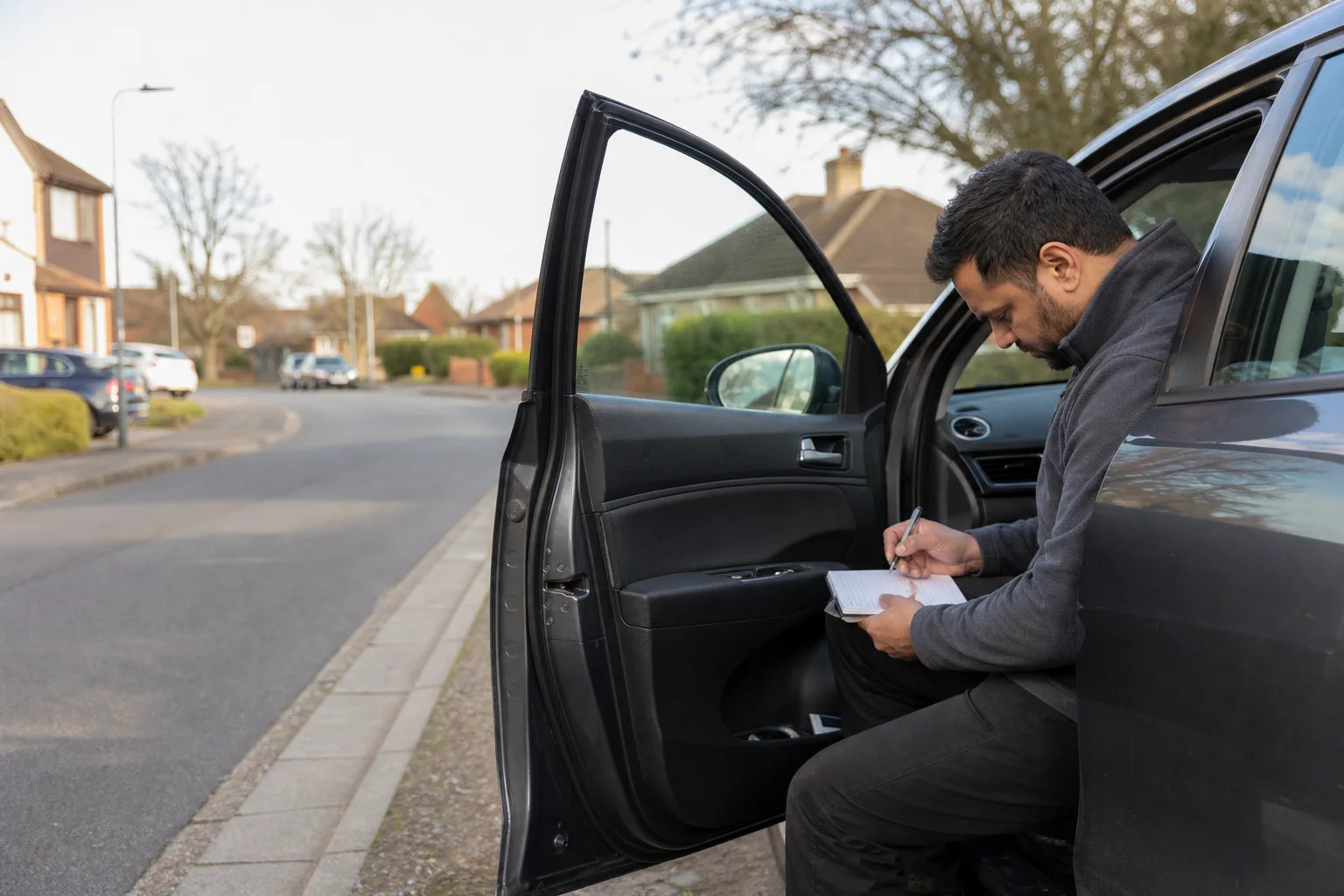
Whichever method you use, a mileage figure with nothing behind it will not survive a check. Keep a contemporaneous log: the date, the journey, the business reason and the miles, recorded as you go rather than reconstructed from memory months later. App statements give you the on-trip miles, but they do not capture the to-pickup, cruising and return legs, so most drivers pair the statements with a dedicated mileage tracking system or a simple running record. That same log feeds straight into the mileage box when you file your Self Assessment return, and it backs up every figure if HMRC ever asks.
Counting your business miles properly is the foundation of the rest of your claim, and it sits alongside knowing which other expenses you can claim as a driver. If you are not sure which of your miles qualify or which method leaves you better off, send us your figures through the form on this page and we will work it through with you.
Get a Free Tax Quote
We specialise in tax for Uber and ride-share drivers. Fixed written quote within 48 hours, no obligation.