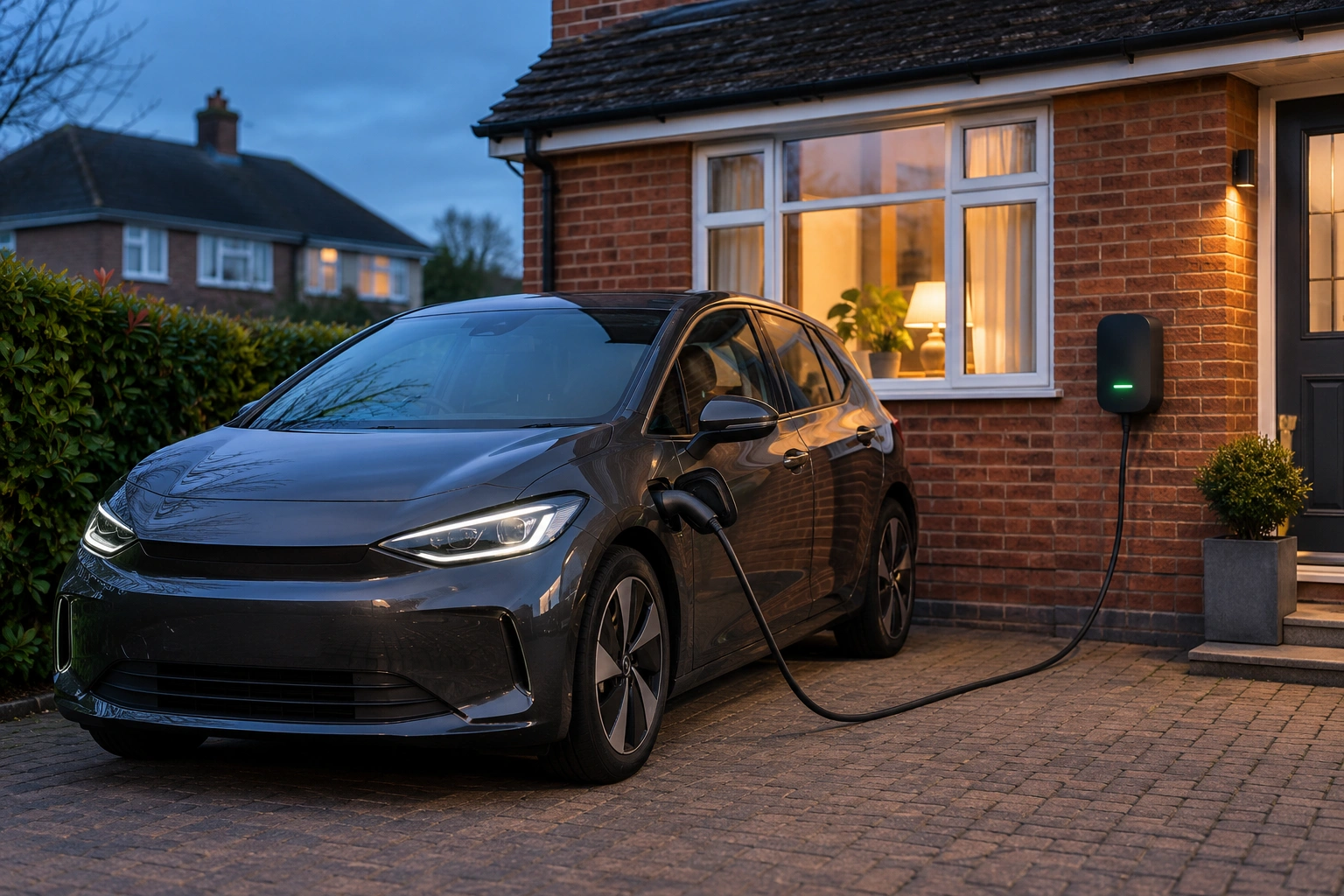
Charging an electric private hire car produces two kinds of evidence. Public charging leaves a receipt for each session, while home charging disappears into the household electricity bill. If you claim actual vehicle costs, your claim for electricity depends on a log that links each session to a price and to the business share of your driving.
This guide covers charging records for UK sole-trader drivers. Purchase reliefs, leasing and road charges for electric cars are covered in electric vehicle tax and records for private hire drivers, so this page stays with the electricity itself.
When Charging Costs Can Be Claimed
Start with the vehicle method on your last return. HMRC’s simplified expenses guidance sets a flat rate per business mile that replaces the actual costs of running the car, so a driver using it does not claim home or public charging on top. Once you use the flat rate for a vehicle, you must keep using it for as long as that vehicle is in the business.
Under actual costs, you claim the business share of the electricity. HMRC’s manual on apportionment accepts that an identifiable proportion of an expense can be deductible, and says motor expenses suit a statistical approach based on a detailed review of a representative period. For a driver, that review is the mileage log, so keep it to the standard described in how to track expenses as an Uber driver.
HMRC Advisory Electric Rates and Sole Traders
HMRC publishes advisory electric rates. From 1 September 2026 they are 7p a mile for home charging and 15p a mile for public charging, worked out from 24.47p per kWh at home and 54.00p per kWh at public slow or fast chargers. HMRC says these rates only apply to employees using a company car and must not be used in any other circumstances.
They are still a useful sense check, because they show how far the price per kWh can differ between a driveway and a public charger. A self-employed driver’s claim comes from the actual sessions and bills, not from a published average.
Public Charging Evidence
Each public network issues a receipt or app record with the date, location, energy delivered, price per kWh and total. Download these regularly rather than relying on an app to keep years of history. Keep any network subscription invoice too, because it is part of the cost of charging. If you pay a discounted rate through a platform or network offer, record the price you actually paid.
Overstay or idle fees for leaving the car connected after charging has finished are a different item. Keep them on a separate line and ask about them, rather than adding them to the energy cost.
Home Charging Evidence
A household bill shows the whole home’s usage, so you need a separate measure of what went into the car. The most reliable source is a smart charger that exports kWh for each session. Without one, take meter readings before and after each charge, or use the car’s own charging history if it records energy delivered. Do not claim the whole household bill or its standing charges as charging costs.
Price each session at the unit rate in force when the car charged. An off-peak EV tariff and a standard rate can be several times apart, and a charge that runs past the end of a cheap window may be priced at both. Keep the bills that show each rate and note the date of any tariff change.
VAT on Charging for Registered Drivers
HMRC’s motoring VAT notice says businesses can recover VAT on charging at work or at public charging premises for the business use of the vehicle, and that a sole proprietor can also recover VAT on business charging at home. The notice tells you to work out the business and private split by keeping mileage records.
The rates differ. HMRC’s fuel and power notice says charging at public charge points is always standard rated, whatever the quantity, because the supply is not made to a home. Domestic electricity is normally charged at the 5 percent reduced rate, but the notice records a temporary zero rate for domestic electricity in Great Britain from 1 October 2026 to 31 March 2027, announced on 21 July 2026. During that period a home bill in England, Scotland or Wales carries no VAT to recover, while Northern Ireland stays at 5 percent. Keep receipts that show the VAT, and treat the car itself separately using Can a Private Hire Driver Reclaim VAT on a Car?.
Working Out the Business Share
Electricity powers every mile the car drives, so the usual basis is business miles divided by total miles for the same period. Take an odometer reading at the start and end of each month and on any day you change car, then compare the total with the business mileage in your log. Apply the resulting share to all the charging costs for that period. Do not also strip out individual sessions as private, or the private use is deducted twice.
Monthly odometer readings will have a second use. The government’s Electric Vehicle Excise Duty policy paper, published on 13 July 2026, confirms a charge of 3p a mile for battery electric cars from 1 April 2028, based on odometer readings and an estimate of the coming year’s mileage. Drivers who already log readings each month will have the figures ready.
Sample Charging Log
The extract below is fictional, and every tariff, price and mileage figure in it is invented. It shows five sessions and two other items from a March log; the totals underneath are for the whole month.
| Date | Where | kWh | Tariff | Cost | Allocation | Evidence reference |
|---|---|---|---|---|---|---|
| 3 March | Home, off-peak | 52 | 7.5p per kWh | £3.90 | Pooled, business share applied | Charger app session export |
| 6 March | Public rapid charger | 38 | 79p per kWh | £30.02 | Pooled, business share applied | Network receipt showing VAT |
| 10 March | Home, off-peak | 55 | 7.5p per kWh | £4.13 | Pooled, business share applied | Charger app session export |
| 18 March | Home, standard rate after the off-peak window ended | 30 | 28p per kWh | £8.40 | Pooled, business share applied | Charger app export and bill unit rate |
| 24 March | Public charger | 20 | 55p per kWh | £11.00 | Pooled, business share applied | Network receipt showing VAT |
| 24 March | Overstay fee at the same charger | None | None | £5.00 | Kept separate for review | Network receipt |
| March | Network subscription | None | None | £7.99 | Pooled, business share applied | Subscription invoice |
In this example the full March log totals £214.60 of charging and subscription costs. Odometer readings show 2,400 miles for the month, of which the mileage log records 2,040 as business miles, a share of 85 percent. The business element is £214.60 multiplied by 85 percent, which is £182.41. The £5 overstay fee is not in that total until it has been reviewed.
Charging Records Checklist
- Note the vehicle method used on your last return before you build the claim.
- Record odometer readings at the start and end of each month, and on the day you change car.
- Keep a business-mile log covering the same period as the charging records.
- Export kWh for each home session from the charger app, or note meter readings before and after each charge.
- Keep every electricity bill that shows the unit rates, and note the date of any tariff change.
- Download public charging receipts and subscription invoices regularly, with the VAT shown where you are registered.
- Leave out any charging paid for by someone else, such as charging included in a rental agreement.
- Keep overstay and idle fees on a separate line for review.
- Keep the records for at least five years after the 31 January deadline for the tax year, as HMRC’s record-keeping guidance requires.
Sole Traders, Companies and Employees
These records are for self-employed drivers. The rules change if the car belongs to a limited company or you drive as an employee. HMRC’s motoring notice says that where an employee charges a vehicle at home, the electricity is supplied to the employee and the employer cannot recover the VAT, and the advisory electric rates apply only to company cars. If you have moved between these arrangements during the year, keep the records for each period apart.
Help Checking Your Charging Claim
If you have home and public charging across several apps, or you are unsure how a tariff change affects the figures, our expense deductions review can check your log, the business share and any VAT before the claim reaches your return. Tell us the tax year, the vehicle method you use and whether you are VAT registered when you ask for a fixed quote.
Official sources checked 27 October 2026. The charging log is an illustration for UK sole-trader drivers. Limited companies and employees follow separate rules for the same costs.
Back to all articles