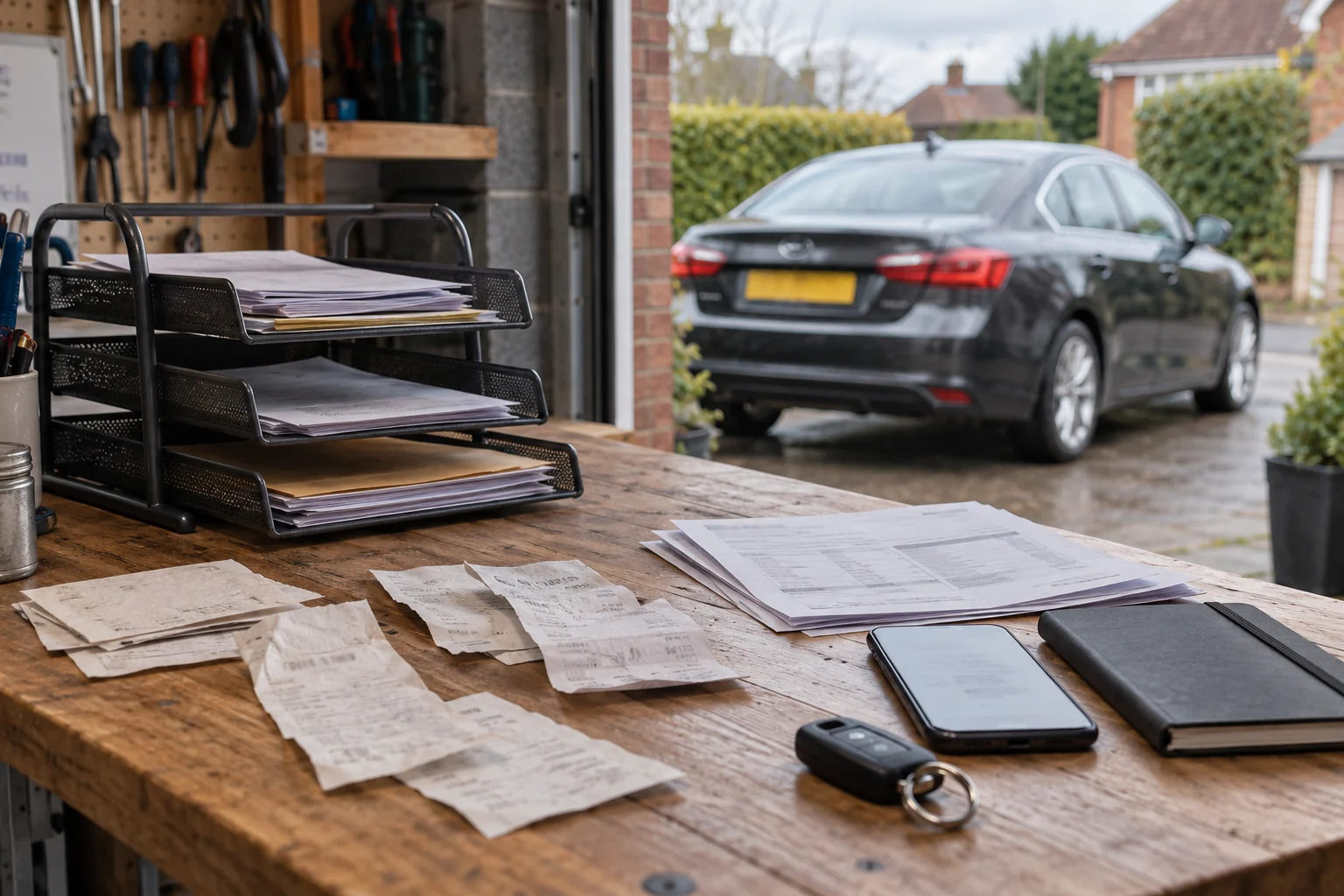
Lost fuel receipts, an old phone or a gap in your Uber downloads can leave you unsure what to put on your tax return. Start by recovering copies and recording what you can confirm. Keep unresolved amounts separate so you and your accountant can see which figures still need work.
This article covers missing evidence for UK sole-trader records. For the rules on which costs you can claim, use our guide to allowable expenses for Uber and private hire drivers. Finding proof of a payment is one step; deciding its tax treatment is another.
List the gaps before rebuilding the totals
Create a folder for the tax year and copy the files you still have into it. Preserve originals, including incomplete exports. Write down the missing dates, platforms and accounts. A missing receipt for one repair needs a different search from three months of missing earnings.
- Mark each gap as income, expense, mileage or another record. Include other driving platforms and cash transactions where relevant.
- Check the period covered by each download. A calendar-year summary will not match the UK tax year from 6 April to 5 April without checking the dates.
- Use your bank statements to find transactions to investigate. Do not treat every credit as driving income or every payment as a business expense.
- List who can supply each missing item and set a follow-up date. Keep copies of requests and replies.
Use the Uber driver Self Assessment document checklist to check the full return requirements before narrowing your search to the gaps.
Recover Uber earnings statements and reconcile the payments
Uber’s UK earnings guidance links to downloadable weekly PDF statements and explains earnings, payouts and adjustments. Sign in through the official driver account, select the missing periods and save the available statements. Search your email for statement notifications if you cannot identify the weeks. Ask Uber support about missing periods or account access.
Compare the recovered statements with your bank credits. Check tips, refunds, platform deductions and adjustments from earlier weeks before treating a difference as missing income. Keep notes explaining timing differences. Adding a statement total to the related bank payout can count the same earnings twice.
For each week, record the statement period, the amounts shown, the payout date and the matching bank reference. Where you cannot reconcile a difference, leave a named gap in your log. Do not fill it with a guessed fee or assume that a bank payout explains the whole week.
Find replacement evidence for expenses and mileage
HMRC’s records guidance includes bank statements, receipts and invoices as types of proof. You must be able to identify business transactions. A bank line can establish that you paid a supplier, but may leave the items purchased or their business use unclear.
| Missing item | Places to check | What still needs checking |
|---|---|---|
| Fuel or charging receipt | Supplier account, email, charging app or duplicate from the retailer | Date, vehicle and business use; a shop payment may include other purchases |
| Garage or tyre invoice | Garage records, booking email and card payment | Work completed, vehicle and invoice details |
| Insurance or vehicle agreement | Broker, insurer, rental company or finance provider | Cover period and payment breakdown; payment evidence alone does not decide the deduction |
| Mileage log | Backups, trip history, diary and dated vehicle records | Business journeys and gaps; odometer readings include private travel |
| Platform earnings | Official statements, trip records and bank payouts | Missing periods, adjustments and any double counting |
Request a duplicate with the supplier name, approximate date and amount. Search old email accounts and cloud backups before assuming a receipt has gone. Save the duplicate alongside the matching payment and a note of the business purpose. Do not create a replacement invoice yourself or alter a receipt.
For a missing mileage period, document the journeys you can support from dated records and identify what remains uncertain. Do not present a reconstructed log as one kept at the time. Platform trip distance may omit journeys or overlap with another app. Our mileage and actual vehicle costs guide explains the method choice; recovering fuel receipts does not by itself decide which method you can use.
Copy this missing-records recovery log
Use one row per missing document or period. The example below is fictional and shows how to separate confirmed evidence from gaps. The amounts are transaction examples, not approved tax deductions. Copy the columns into your own working document and replace the entries.
| Record and amount | Evidence recovered | Status | Next action and owner | Treatment to resolve |
|---|---|---|---|---|
| Repair invoice, £180 | Duplicate invoice and matching card payment | Confirmed evidence | Driver: file both copies today | Check business use and vehicle-cost method |
| Fuel payment, £62 | Bank entry only; retailer copy requested | Partial evidence | Driver: follow up with retailer in 7 days | Contents of purchase and business use unresolved |
| One week of Uber earnings, amount unknown | Bank payout found; statement missing | Unresolved gap | Driver: request statement and send to accountant | Reconcile earnings and deductions before completing total |
| Missing mileage week, distance unknown | Some trip records and diary entries | Reconstruction in progress | Driver: list supported journeys for accountant review | Identify any estimate and explain its basis |
Add the transaction date or missing date range, a file reference and the date you last checked each row. Keep a separate calculation sheet if one row needs an estimate. Record the evidence used, assumptions, arithmetic and any private-use adjustment. Update the status when you receive a document, without deleting the history of what was missing.
Confirmed evidence means you have recovered the supporting material. It does not mean HMRC has agreed a claim. Partial evidence means you still need an explanation or document. Keep unknown amounts visible; entering zero can conceal an unresolved income gap.
Estimated and provisional figures: tell HMRC what you used
HMRC explains what to do with lost records: try to replace them, and if you cannot, do your best to provide figures. When filing, tell HMRC if you use estimated figures because actual amounts are unavailable, or provisional figures while waiting for actual amounts. You must submit the actual figures when they become available after using provisional figures.
Discuss each unresolved row with your accountant before filing. Agree the calculation and how to disclose it on the return or through the software you use. Keep your recovery log and workings with the return. Do not apply an unsupported percentage to a whole year or assume a small amount needs no explanation.
A filing deadline still needs attention while you chase records. If it has already passed, follow the missed Self Assessment deadline steps alongside the recovery work. Missing evidence does not automatically remove a filing obligation or penalty.
New evidence after you have filed
Compare the recovered records with the figures submitted. If they change the return, use HMRC’s correction guidance. You can normally amend within 12 months of the Self Assessment deadline. For an older return or a missed amendment deadline, HMRC explains the written route. Keep the original calculation, corrected calculation and filing acknowledgement together.
For example, if you used a provisional amount while waiting for an earnings statement, record the statement’s arrival date and ask your accountant to replace that figure with the actual amount. Set a follow-up date when you file so the open item does not disappear from your task list.
Hand over a clear recovery pack
- Provide the tax year, platforms and accounts covered, with the original exports and recovered copies.
- Include the recovery log, calculation notes and a list of unresolved gaps, with an owner and follow-up date for each.
- Explain any amounts already included in a return, especially estimates or provisional figures.
- Ask your accountant to confirm the next filing or correction step and the evidence still needed.
For help preparing the return from your recovered records, ask about our Uber tax returns service. Describe the missing periods in your enquiry; arrange secure document sharing before sending statements or identity details.
Keep sole-trader records for at least five years after the relevant 31 January submission deadline. HMRC sets a different retention period for returns filed more than four years late; check its record-retention guidance for that situation. Once you have dealt with the gaps, use how to track expenses as an Uber driver to set up the ongoing routine.
Official sources checked 15 October 2026. This article addresses recovery of UK sole-trader records for Self Assessment; VAT evidence and company accounts may need separate checks.
Back to all articles